In the Footsteps of Ed Ricketts
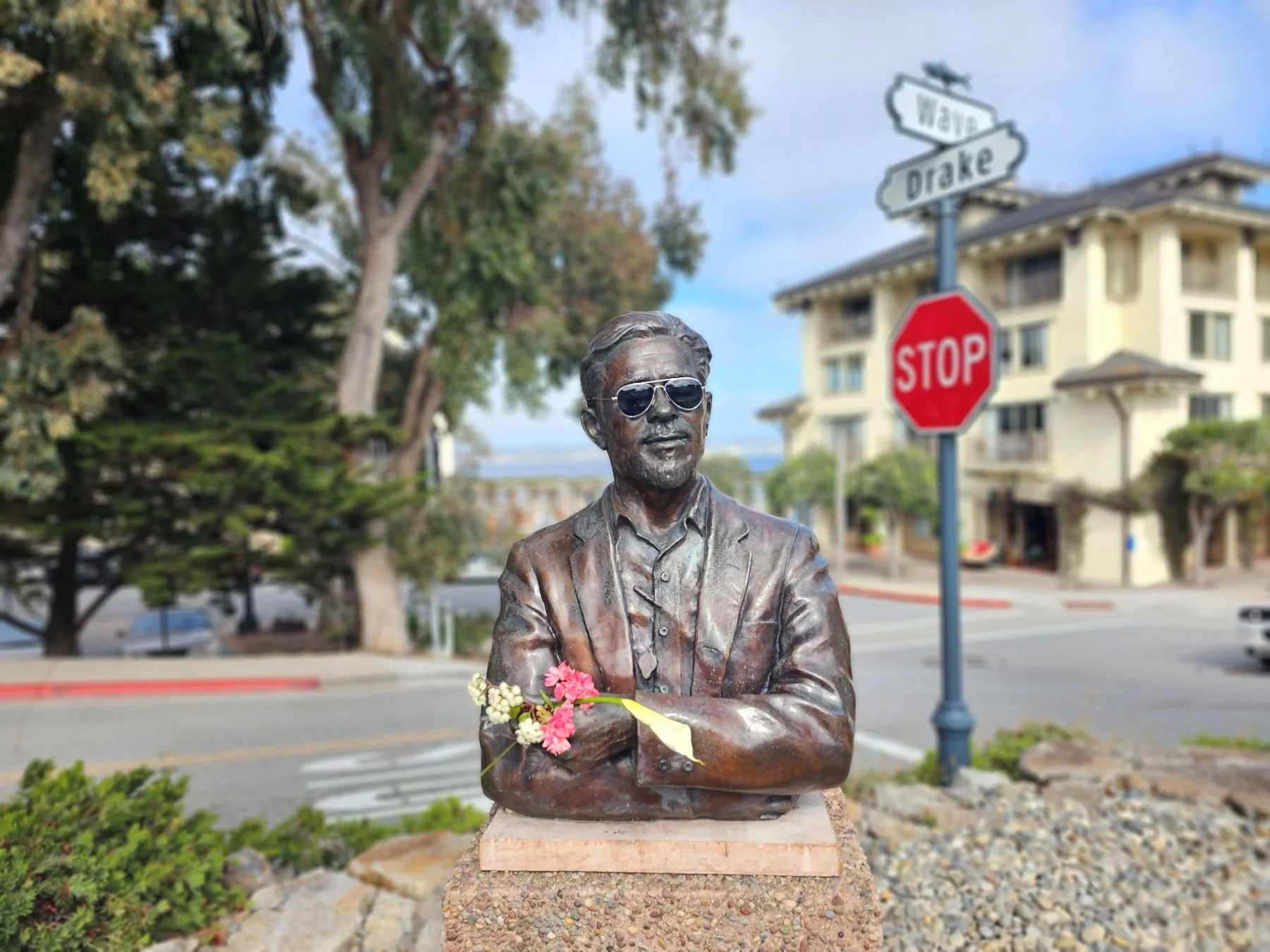
It’s a pearl grey morning in Monterey when I visit the bronze bust of Ed Ricketts. It stands at the intersection of Wave Street and Drake Avenue, beside Monterey Bay Recreation Trail. Cyclists whizz past behind me on e-bikes following what used to be the route of the railway line as I read the inscription beneath the bust.
Edward Ricketts
1897 – 1948
Marine biologist, philosopher, writer, ecologist, and friend to many. Immortalised as ‘Doc’ of John Steinbeck’s Cannery Row, the real man had a profound influence on the thinking of writers, artists and scientists.
With hair swept back from his broad brow, he looks suave, contemplative and kind. A pen is tucked between the buttons of his shirt beside a magnifying loupe. He holds a sea star. Bright against the bronze, a posy of freshly picked flowers has been carefully tucked into his hand. The tiny explosion of purple creeping lantana, long yellow petals of capeweed, and bright red burst of bottlebrush is a touching gesture.
Many people know Ricketts as the inspiration for Steinbeck’s character ‘Doc’, but it’s important to distinguish between the two to appreciate his achievements and truly honour his memory. His extensive and meticulous collecting and documenting of marine life found on the shores of the American west became the tome Between Pacific Tides, the first edition of which was published in 1939. Now on its fifth edition, it’s the biggest selling book ever published by Stanford University Press. Between Pacific Tides was revelatory for his pioneering ecological approach: grouping organisms by their shared habitat, rather than taxonomically, and recognising the interconnected communities they formed.
Just two years later, Sea of Cortez: A Leisurely Journal of Travel and Research, written by Ricketts and Steinbeck, was published in 1941. It’s a wondrous and, at times, hilarious account of a six-week trip they took around the coast of Baja on Western Flyer, a sardine fishing boat they chartered. As well as detailing their observations of marine life, they sought a greater understanding of the region’s ecology. Their curiosity didn’t end there; documented too are the people they met, the places they visited and their own foibles. “Toward the end of our preparation, a small hysteria began to build in ourselves and our friends,” they wrote. “There were hundreds of unnecessary trips back and forth. Some materials were stowed on board with such cleverness that we never found them again.” Their reluctant use of a navigation guide they felt was compiled by “cynical men […] writing for morons”, their inability to capture helpful photos or film, and their reliably unreliable outboard engine are all running themes in the book. The engine, which they called the Sea-Cow, was brought along to propel the skiff they used during collecting trips and becomes a significant character – a character of “soul and a malignant mind” – for “the Sea-Cow loved to ride on the back of a boat, trailing its propellor daintily in the water while we rowed.” The result is a humble and whimsical log of their adventure.
Four years after Sea of Cortez and 15 years into their friendship, came Steinbeck’s novel, Cannery Row. Selling 14 million copies by its 75th anniversary in 2020, it’s little wonder the novel’s opening sentence is familiar to so many. “Cannery Row in Monterey in California,” wrote Steinbeck, “is a poem, a stink, a grating noise, a quality of light, a tone, a habit, a nostalgia, a dream.”
Turn back a page and you’ll find a disclaimer. “The people, places and events in this book are, of course, fictions and fabrications.” Of course.
Turn back another page and you’ll find, “For Ed Ricketts who knows why or should.”
Much of the novel revolves around Doc and his home and workplace, Western Biological Laboratory, which sits sandwiched between sardine canneries on Cannery Row and “sells the lovely animals of the sea.” Across the street lies a vacant lot and Chong’s grocery store. Ed Ricketts worked out of Pacific Biological Laboratories, which still stands on Cannery Row. The vacant lot across the street remains, as does faded signage on Chong’s grocery store, which now sells sea otter regalia and overpriced sweets. Fact and fiction are as interconnected as the marine communities that Steinbeck and Ricketts dedicated so much time to.
Now, Monterey Bay Aquarium towers on one side of Pacific Biological Laboratories, an InterContinental hotel on the other. Gone are the sardine canneries. The Lab, however, looks unchanged from black and white photos taken in the 1940s. The dark wooden shiplap sliding from which the lab was rebuilt after a ferocious fire is laid horizontally, emphasising the squat building. A flight of stairs leads to a front door on the first floor. There’s a panel of small paned windows and, at street level, an entrance to a garage. Between gaps in the traffic and groups of visitors drifting past, I take yet more photos and marvel at my good fortune at being able to join a private tour of the Lab.

Ron, our tour guide, is a biology teacher at the local high school and clearly a huge fan of Steinbeck, Ricketts and Cannery Row. Three others comprise the tour, two of whom remain quiet while the third gushes, “Gosh, what a treat to come in here. Wonderful. I've probably read Cannery Row five times, and I've only seen the Lab from the outside, and it's so wonderful, so thanks for taking the time out to be here.”
Inside, it’s a mixture of original features and paraphernalia. There’s a model of the building encased in glass. Articles and illustrations cover one wall, curling at the corners. On the first floor now, above the traffic and tourists, it’s hard to pinpoint the era we’re in. We sit on a semi-circle of chairs and Ron begins, introducing us to Steinbeck and Ricketts and showing us old photos of the inside of the Lab, pointing out where the fold-down table was, Ricketts’ narrow bed beneath the window, his vast collection of biological books. Ron is on a roll now, talking us through Steinbeck and Ricketts friendship. “They were two men of a kindred spirit, they both were fascinated with the way the world worked,” he tells us. “They both loved talking about philosophy. They both loved listening to music.” A dusty Garrard turntable sits in the corner on a mug-ringed wooden table, and a radio sits on a shelf above a collection of records.
Their lives were very much entwined. Steinbeck wrote at the Lab. His wife, Carol, was employed there. Steinbeck often joined Ricketts on his collecting trips, and both Steinbeck and his wife went on the 1940 scientific trip around the coast of Baja. Ron tells us that when Ricketts first read Cannery Row and was asked what it was about, he replied, “Well, it’s a book about me.”
While the people, places and events in Cannery Row are – of course – fictions and fabrications, many of the characteristics Steinbeck attributed to Doc, he later also wrote of Ricketts in The Log of the Sea of Cortez. Both were endlessly curious, observing and questioning the behaviours of species. Both were deeply philosophical. “Doc would listen to any kind of nonsense and turn it into wisdom,” wrote Steinbeck in Cannery Row, while Ricketts wrote philosophical essays. Both were empathetic and compassionate, tending to peoples’ minor illnesses and injuries. Both would readily wade into tide pools but hated getting their head wet. Both tipped their hats to dogs they passed in the street. After realising Cannery Row was about him, Ron tells us that Ricketts added, “I cannot fault John for what he wrote in the book, because none of it is false, it just may not be 100% real.”
Cannery Row is no longer a stink, nor a grating noise. In the late 1940s and early 1950s, the silver stream of sardines ran dry. Monterey remains a dream, though, particularly for marine biologists like Doc and Ricketts. And like me. A chapter in Cannery Row begins, “Doc was collecting marine animals in the Great Tide Pool on the tip of the Peninsula. When the tide goes out the little water world becomes quiet and lovely. The sea is very clear and the bottom becomes fantastic with hurrying, fighting, feeding, breeding animals.” The hurrying, fighting, feeding marine life found between, and beyond, the tides still draws crowds to Monterey, to dive in the kelp forests and take boat trips into the bay.
In a chapter Steinbeck later added to Sea of Cortez before it was re-published as The Log from the Sea of Cortez, he recalled how, after a spell working for the railroad, Ricketts had developed “a disgust for exactness in time. […] If you asked him to dinner at seven, he might get there at nine.” The exception to this was when planning his collecting trips around the tides. “If a good low collecting tide was at 6:53, he would be in the tide pool at 6:52,” wrote Steinbeck. Unwilling to visit Monterey without seeing the Great Tide Pool for myself, I checked tide times weeks in advance. The good low tide – for looking, not collecting – fell at 6:40 on my last morning in Monterey. Usually reluctant to rise so early, I considered I might be rewarded with a beautiful sunrise. Instead, dense fog shone silvery around streetlamps and headlights as I cycled to the tip of the peninsula, past iconically twisted Monterey pines.
On my last visit, the Great Tide Pool had been a curve of blue Pacific topped with whipped peaks of white water. Small choppy waves rolling in lifted and lowered broad fronds of kelp as they passed. Now, it looked like someone had pulled the plug. Kelp lay draped over boulders as the outer ocean lapped at the edges of the bay, grey and restless.
With whorls tightly wound, turban snails rolled from rocks and plopped into small pockets of water, vanishing behind reflections as I slipped and slid over boulders. Crabs scuttling into crevices added to the pool’s soundtrack of gurgles and pops. Purple urchins armed with long spines clustered between rocks. Anemones as big as my hand were marbled in shades of purple and green. A flame lined chiton – armour plated and clamped to the rock – wore wavy stripes of dark brown and brilliant blue. Waiting for the tide to turn, the pale calcareous plates of gooseneck barnacles tapered to a tip like sperm whales’ teeth. Then, I spotted what I’d barely entertained, had hardly dared to dream of.
I crouched to look closer. Thin dark vessels marbled its pale skin. It didn’t move. I took some photos. It still didn’t move. “The creeping murderer” as Steinbeck called it, appeared to be dead.
“Excuse me,” I called to a young woman searching in a tide pool not far from me. “I think I’ve found an octopus.”
“But it might be dead,” I added as she hurried over.
Lying on a rocky ledge, the octopus gently recoiled a tentacle at her touch. Movement. She touched it again. More movement.
Reaching into the crevice, she gently lifted it. The octopus was sickly white and deflated. It pooled in her palm, tentacles dripping through her fingers, pale brown now.
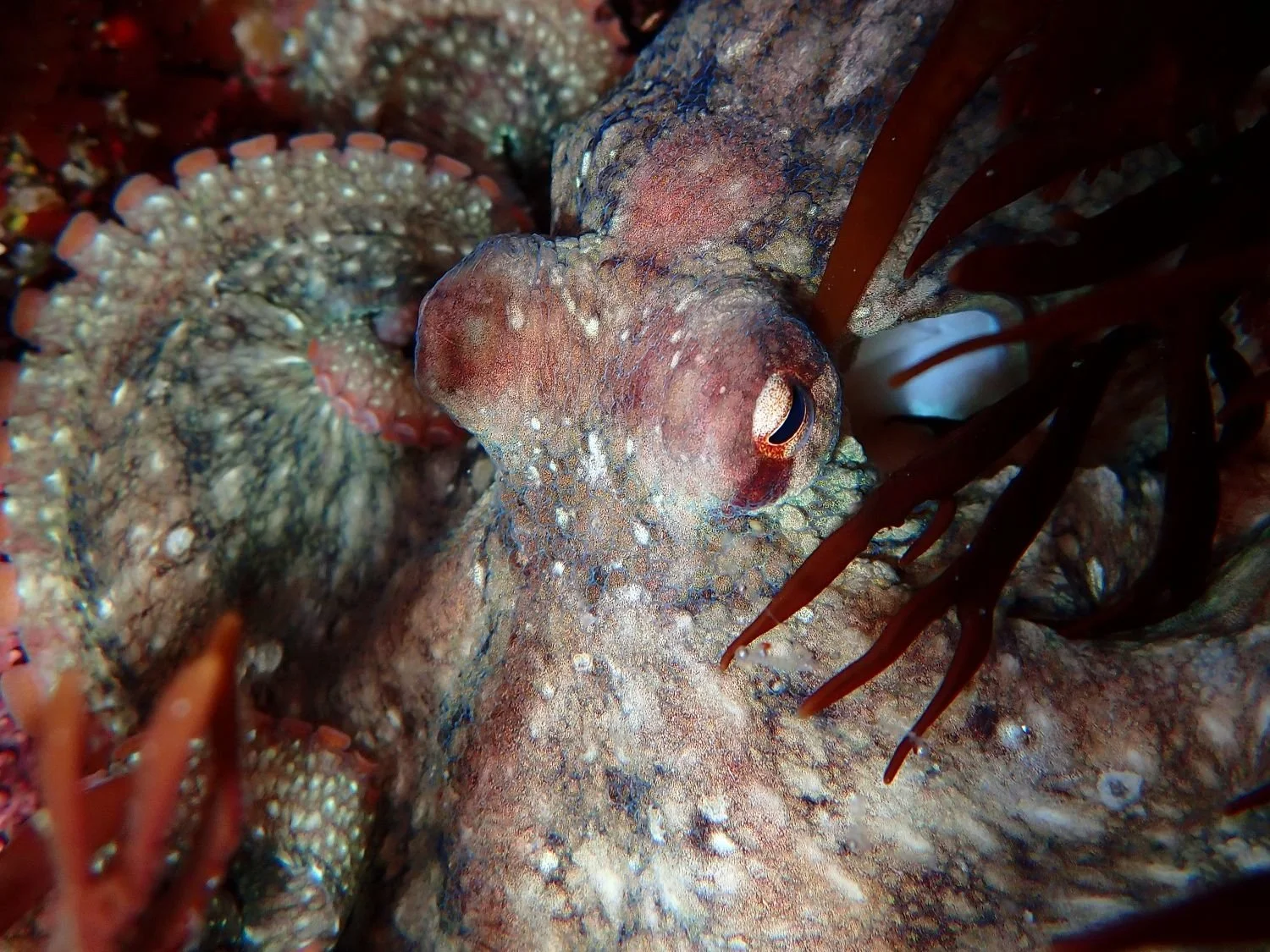
“Maybe it’s been out of the water too long,” she said, looking around for a tide pool to place it in. As she lowered the octopus into a pool it reclaimed its dimensions, its soft mantle pulsing. Siphons worked – water in, water out, water in, water out. Three hearts distributed oxygen circulating in its blue, copper-rich blood. Periscope eyes perched atop its mantle, surrounded by curled tentacles, spirals of suckers. Its horizontal pupils were blacker than black, surrounded by an iris pinpricked with pigment.
Revived to a degree, the octopus activated its camouflage. Gone was the slick, sickly skin of five minutes before. Now its skin was gently warty with projections – papillae – like the topography of the tide pool, which was lined with life and decorated with fragments of broken shells. Tiny elastic chromatophores expanded or contracted to match the colours and patterns of the pool. Its pink hue and pale spots mirrored encrusting coralline algae coating the rocks beneath the water line. The sides of its suckers flushed orange – a lighter shade of the dark red algae hanging beside the octopus. The closer I looked, the more colours I saw. Greens, yellows, reds, purples. Drawn in dots, a constellation of colours, a movable tattoo. Closer still, a fine network of electric blue traced lines between clusters of chromatophores. From afar, the octopus blended with its surroundings. Up close it glowed electric blue, as mesmerising as the Milky Way.
Ron had a theory the peninsula’s tide pools go further than merely setting the scene for Doc’s work in Cannery Row. “I like to argue that Cannery Row is a book about biology. Remember that John Steinbeck spent more than a decade going out into the tide pools here with Ed Ricketts,” he told us. “Each of those little vignettes is a story of ecology. It is Steinbeck looking into this tide pool of the community and describing what's happening, how things are interacting.” We nodded as we contemplated this, standing amongst Ricketts’ records and collecting jars, utterly engrossed. “And you'll notice that the character Doc, whenever he leaves the scene, everything goes to hell, and when he comes back, everything gets returned to order,” Ron continued. “In the world of ecology, Doc is the keystone species of those ecosystems. And when the keystone species is removed, the ecosystem collapses.”
That ecosystem collapsed in May 1948.
A photo taken in the aftermath of the accident shows Ricketts curled on the ground. A policeman crouches beside him. The roof of his Buick has buckled. Windows have shattered. Behind him, the express train is unscathed.
In the wake of his death, “everyone who knew him turned inward,” wrote Steinbeck in the eulogy to Ricketts he added to The Log of the Sea of Cortez. “No one wanted company. Some went to the beach by the Great Tide Pool and sat in the coarse sand and blindly watched the incoming tide creeping around the rocks and tumbling in over the seaweed,” he continued. “We were lost and could not find ourselves.”
There’s one last visit I want to make before leaving Monterey, to pay my respects to this great figure. Still sandy and salty from my exploration of the Great Tide Pool, I coast along Monterey Bay Recreation Trail on my rented e-bike, past harbour seals hauled out in sandy coves, round as pebbles with plump pups at their side. Past the Edward F. Ricketts State Marine Conservation Area lying off the shore of Cannery Row, within Monterey Bay National Marine Sanctuary. Past sea otters – another keystone species – wrapped in kelp just beyond the pilings of ruined canneries. I return to the bronze bust of Ed Ricketts with the intention of replacing the flowers he holds. There’s no need. Not only is he holding a bunch of white Monterey lilac, a mass of pink sweet peas, and a long-stemmed calla lily, he’s also sporting a pair of sunglasses.
The inscription beneath Ed Ricketts’ bronze bust ends, “his influence on the world community and the people of Cannery Row will live forever.” After years of restoration, Western Flyer returned to Baja in 2025, retracing the route of Ricketts and Steinbecks expedition of 85 years ago. Resplendent in her fresh coats of paint, she – and her crew of scientists – were met with interest and enthusiasm up and down the peninsula, and there are plans for Western Flyer to sail from her home in Monterey Bay to the Sea of Cortez every other year. The people of Monterey have not forgotten Ed Ricketts.